What is an AI agent?
An AI agent is an LLM with a role, an objective, memory and tools it can call. Agent vs workflow, multi-agent roles, and how HiveFlow implements them.
An AI agent is a language model given four things: a role (who it is), an objective (what it must achieve), context/memory (what it knows) and tools (what it can do). Unlike a plain chatbot, an agent doesn't just answer — it decides and acts: it can query a database, create a CRM record or call an API, then use the results to continue reasoning.
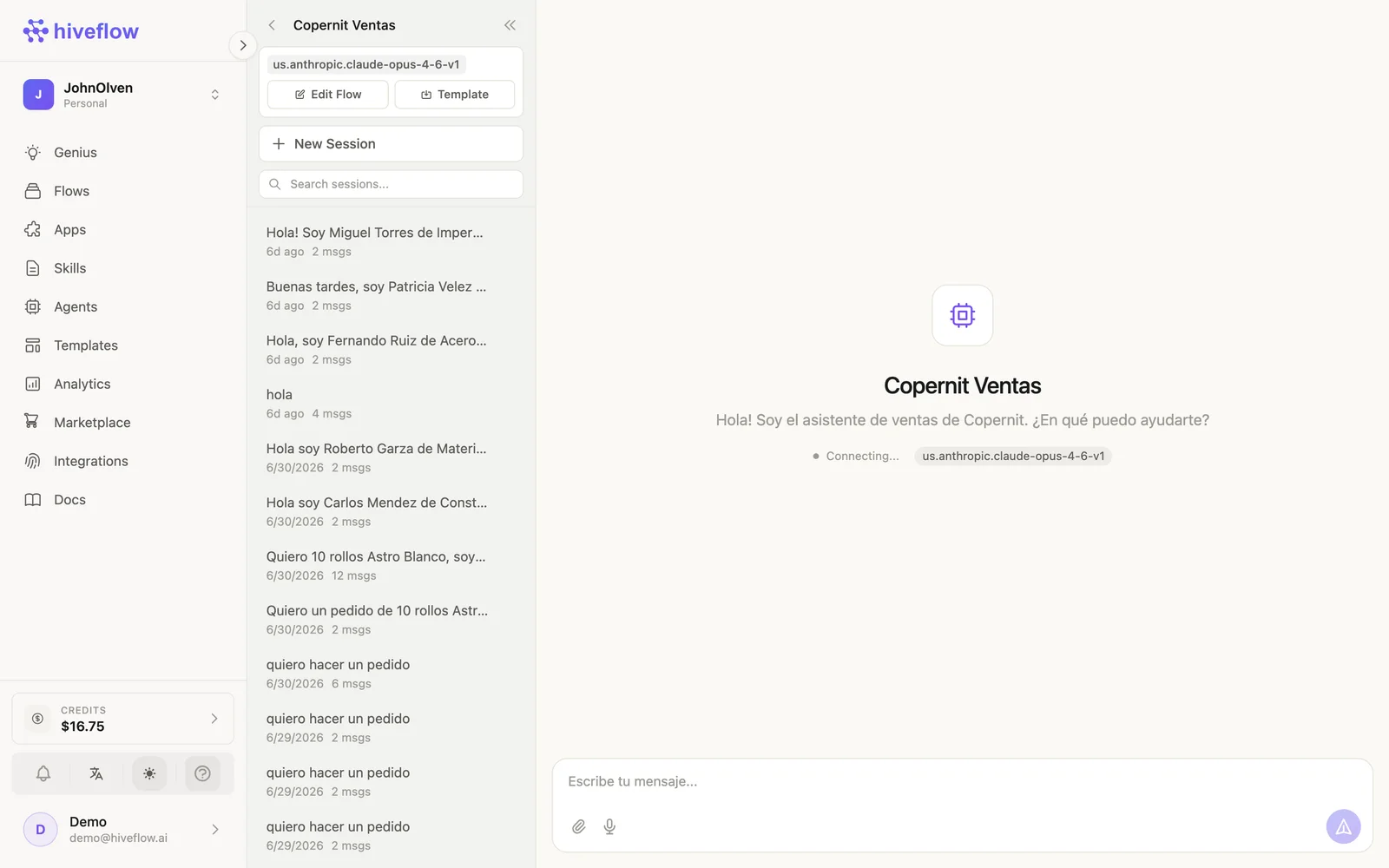
In HiveFlow, an agent is concretely the LLM Agent node inside a workflow — or, packaged with a chat interface, an Agent in the Agents section.
Agent vs. workflow
They answer different questions:
- A workflow is the structure: the fixed graph of steps, conditions and connections.
- An agent is an intelligent step: within its node, the model chooses dynamically what to do — including which tools to call and in what order (function calling).
The design skill is choosing where each belongs: deterministic parts (validation, routing, persistence) as explicit nodes; open-ended parts (conversation, interpretation, tool choice) inside agents. HiveFlow lets you slide that boundary freely on the same canvas.
Multi-agent systems
Complex automations often split responsibilities across several agents — common roles include:
| Role | Responsibility | In HiveFlow |
|---|---|---|
| Supervisor / Orchestrator | Routes work to the right specialist. | An LLM node with Conditional Flow branches, or Genius itself |
| Planner | Breaks a goal into steps. | An LLM node whose output feeds the next stages |
| Executor | Performs the steps with tools. | LLM nodes with MCP / Hive App tools |
| Reviewer / Critic | Checks quality before delivering. | A second LLM node validating the first one's output |
| Memory / Knowledge | Keeps and retrieves context. | Memory & Database nodes, Skills |
Chain them as nodes, or isolate each role in its own flow and compose with Sub-flow nodes.
What makes an agent good
- A sharp objective — the system prompt does most of the work.
- Few, well-named tools — models choose better among five clear tools than twenty vague ones.
- Knowledge as Skills, actions as tools — don't force tool calls for things the agent should simply know.
- Observability — read the Function Calling Process console after every iteration.
Next: the glossary defines every term in the HiveFlow domain.