What is a workflow?
A workflow is an automated process defined as connected steps: a trigger, inputs, logic, AI agents, tools and outputs. Every element, mapped to HiveFlow.
A workflow (or flow) is an automated process expressed as a graph of connected steps: something triggers it, data flows through nodes that transform it, decide, call AI agents and tools, and the result reaches one or more outputs. If you can draw a process as boxes and arrows, you can express it as a workflow.
HiveFlow is a visual platform for building, running and monitoring multi-agent AI systems for businesses — in it, workflows are drawn on a canvas and executed by the platform, with no servers or glue code.
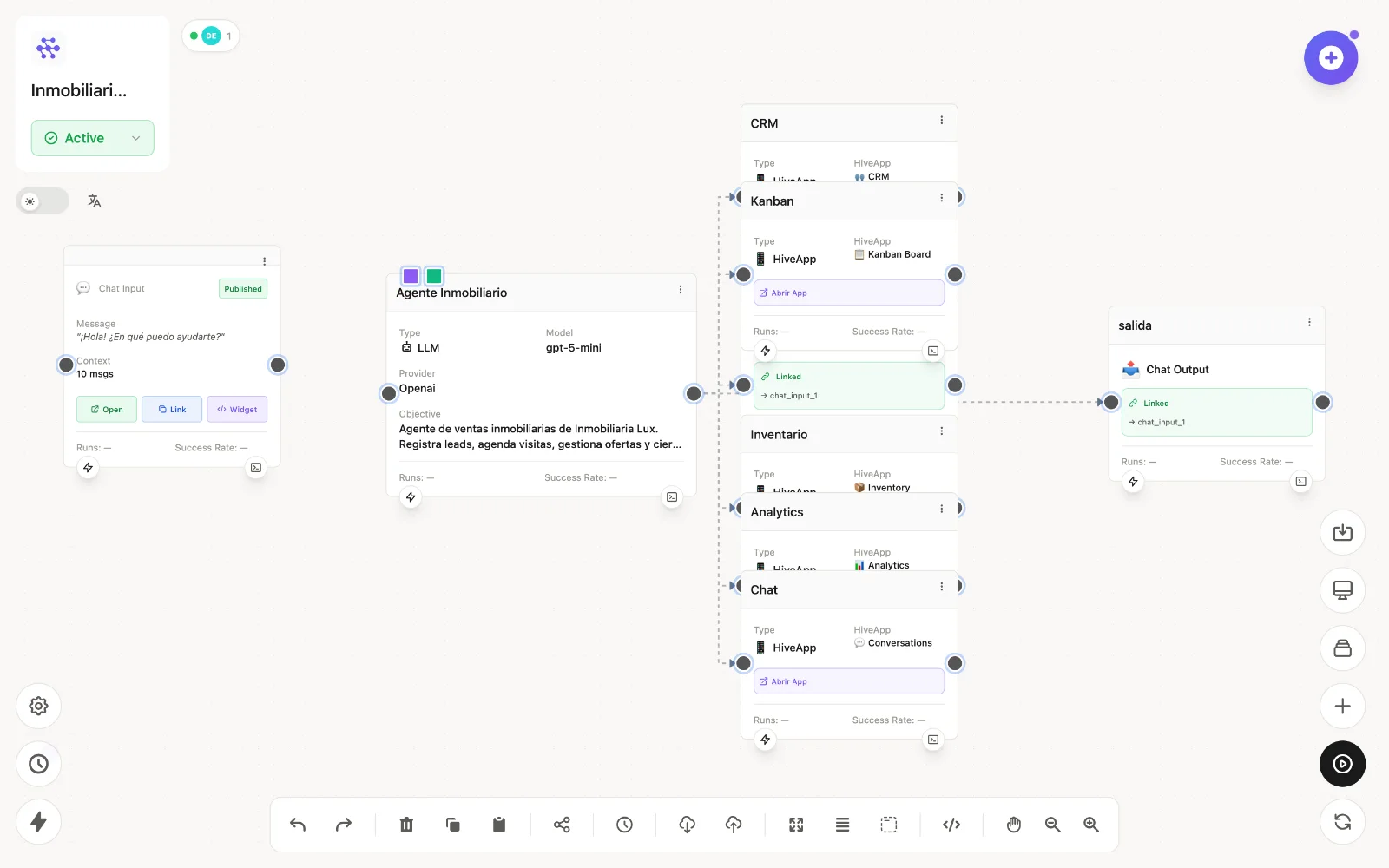
The anatomy of a workflow
Every serious workflow system involves the same elements. This table defines each one and shows how HiveFlow implements it:
| Element | Definition | In HiveFlow |
|---|---|---|
| Trigger | What starts the flow: webhook, form, chat message, schedule, event. | Trigger / Flow Input nodes, 7 channels |
| Inputs | The data the flow receives: text, files, JSON, parameters. | Flow Input fields, form/chat inputs |
| Context | Session memory, shared variables, external knowledge. | Chat context windows, Skills, Memory node |
| Nodes | Each logical step of the process. | 44-node catalog |
| AI agents | LLMs with a role, objective and tools. | LLM Agent node, Agents |
| Tools | External capabilities the AI can call: APIs, databases, SaaS. | MCP integrations, Hive App tools |
| Conditions | If/else branching and business rules. | Conditional Flow node |
| Loops | Repeating over items or until a condition. | Loop node |
| Parallelization | Running branches simultaneously. | Multiple outgoing edges; Merge rejoins them |
| Transformers | Converting data between shapes and formats. | Transformer, Code, Pandas Processor |
| Validation | Checking format, schema and quality. | Conditional/Filter nodes, typed form fields |
| Human in the loop | Pausing for human approval. | Human in the Loop node |
| Memory & state | Data that persists across steps or runs. | Memory / Database nodes, flow variables |
| Error handling | Retries, fallbacks, catching failures. | Error Handler node |
| Observability | Logs, metrics, traces, cost. | Node Consoles, Analytics, credit tracking |
| Versioning | Snapshots and rollback of the definition. | Versions in the editor toolbar |
| Security | Permissions, secrets, authentication. | Organizations, roles, API keys |
| Outputs | The result: messages, files, API responses, dashboards. | Flow/Chat Output, Visual nodes, Hive Apps |
Workflow vs. AI workflow
A traditional workflow (Zapier-style) moves data between apps with fixed rules. An AI workflow adds reasoning: one or more steps are AI agents that interpret free-form input, make decisions and call tools dynamically. HiveFlow is designed for the second kind — the fixed structure lives on the canvas, the intelligence lives in the LLM nodes.